
ChatGPT Ads Product Updates: 9 New Features Announced in September 2026
On September 16, 2026, OpenAI shipped its biggest advertising feature drop of the quarter: impression-based conversion optimization, flexible attribution windows, granular platform targeting, Shopify and HubSpot integrations, AI-assisted ad creation, adaptive ad copy, Event Quality Score, and a first look at Sponsored Agents. Here is what every feature does, which ones are live today, and what changes for your campaigns.
Source: OpenAI Ads Platform — product update email, September 16, 2026 ↗
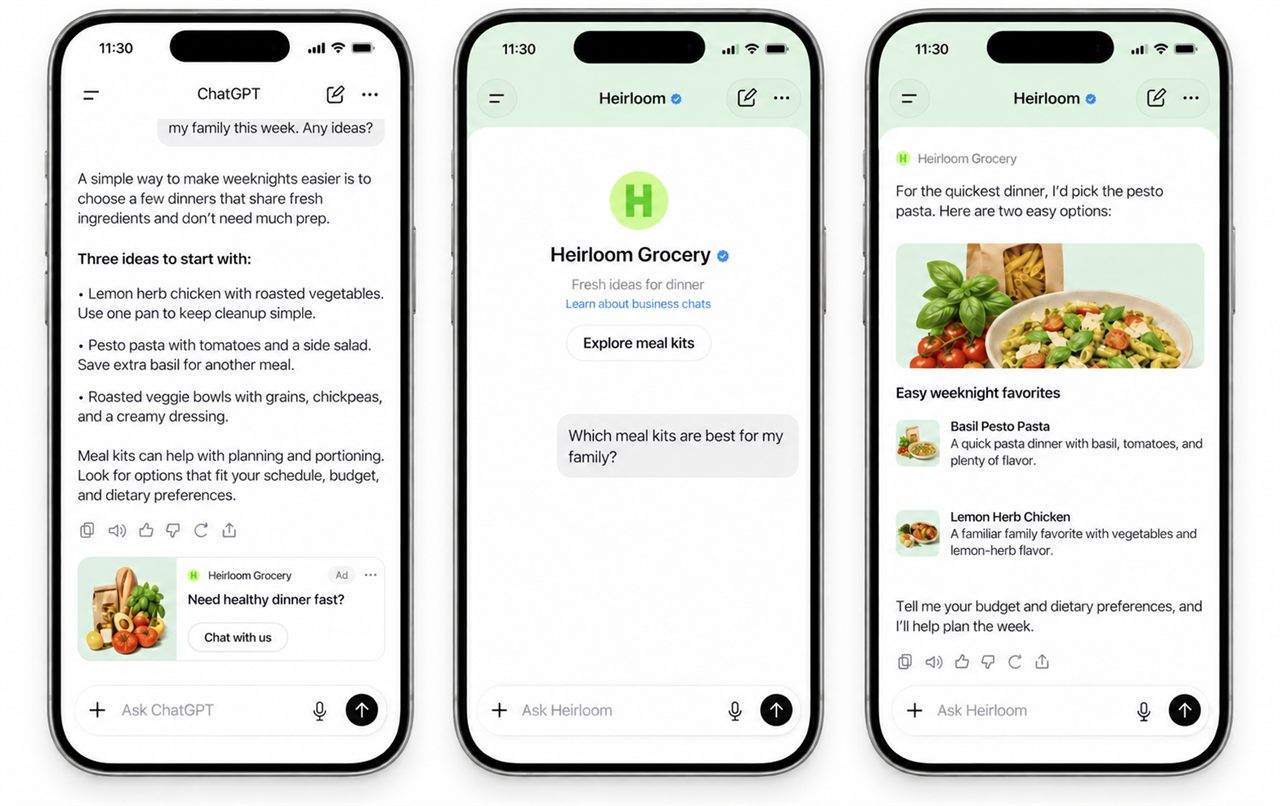
The Sponsored Agents ad experience in ChatGPT — a clearly labeled conversation with a business-sponsored agent.
All 9 Updates at a Glance
| Update | Status | In one line |
|---|---|---|
| Impression-billing conversion campaigns | Generally available | Optimize for click + view conversions while billing by impressions. |
| Flexible attribution windows | Generally available | 7/14/30-day click and 0/1-day view windows in Ads Manager columns. |
| Granular platform targeting | Generally available | Target and segment Android/iOS app and web, plus desktop web. |
| Shopify integration | Live (US), more countries this month | Connect catalog + measurement from the Shopify App Store. |
| HubSpot integration | Live | Create ads, track performance, and follow up leads in HubSpot. |
| AI-assisted ad creation | Testing, wider rollout coming | Suggested copy and imagery from your landing page and objective. |
| Text customization | Opt-in | Adapt copy to context and translate to the user's language. |
| Event Quality Score | Available | 1-10 setup score for Pixel and Conversions API data sources. |
| Sponsored Agents | Testing (select US advertisers) | Users chat with a labeled business agent after clicking an ad. |
Conversion Optimization with Impression Billing (Now Generally Available)
This is the headline update. A new campaign type, now generally available, optimizes for conversions from both ad clicks and ad views — rather than click conversions only — while billing stays impression-based. Delivery is tuned toward your conversion goal, and OpenAI calls it the recommended model for maximizing performance.
What changed in practice: previously, view-through conversions were tracked but excluded from optimization and from the Conversions column. Now a campaign can learn from people who saw an ad and converted without clicking, then their impressions become billable events. The trade-off is worth understanding before you switch — you pay for impressions on delivery, including impressions that never convert, and the algorithm decides which placements and hints extract the most conversions per impression.
For teams running a solid conversion tracking setup with the pixel and Conversions API, this is usually the right default. If your conversion volume is thin, the learning engine has less signal to optimize against — give it a full conversion window before judging.
Flexible Attribution Windows
When customizing columns in Ads Manager, you can now choose a 7-, 14-, or 30-day click window and a 0- or 1-day view window for conversion reporting. The preference applies to all conversion columns you display, so every metric in your view — Conversions, CPA, ROAS — uses the same window.
This matters because window choice changes what “performance” means. A 7-day window suits impulse research products; a 30-day window captures the long, considered B2B sale. Pick windows that match your buyer's research cycle, not your competitor's. Note that this changes reportingattribution — bidding still optimizes on the model's learned value.
Granular Platform Targeting
You can now target Android app, Android web, desktop web, iOS app, and iOS web separately in Ads Manager and the Advertiser API. Performance insights can also be segmented by platform.
If your conversion rate is dramatically different between mobile and desktop, this lets you shift budget instead of guesswork — bid more to the platform that converts, or create platform-specific ad copy. It also gives app developers a native path: iOS app and Android app are now first-class placements rather than afterthoughts.
Shopify & HubSpot Integrations
Shopify. US-based merchants can install the ChatGPT Ads app from the Shopify App Store to connect their product catalog and measurement tools, create ChatGPT Ads campaigns, and track performance without leaving the admin panel. International availability is planned for later this month. For Shopify owners already running the Ridoway Pixel (WordPress) style of server-side tracking, the native app covers catalog syncing on top of event measurement.
HubSpot. HubSpot users can connect a ChatGPT Ads account, create ads, track performance, and follow up on leads directly inside HubSpot. The lead hand-off matters most here: the same conversation that produces a lead can be routed into your CRM without a manual export step.
AI-Assisted Ad Creation
When creating an ad, advertisers can now receive suggested copy and imagery based on their landing page and campaign objective, then review and edit the suggestions before adding them to a campaign. The feature is currently in testing, with broader availability expected in the coming weeks.
The key detail is the review step: nothing gets published automatically. Advertisers stay in the loop, which keeps creative control where it belongs. If you want to see the alternative to a hand-rolled copy pipeline, our ChatGPT Ads copy generator does the same job standalone today.
Text Customization & Translation
Advertisers can opt into text customizationthat adapts existing headlines and descriptions to better fit the context of a conversation, and can translate ad copy into a user's preferred language. Advertisers remain in control of whether the setting is enabled.
This is an opt-in, not a default — and that control matters for brand voice. Two practical notes: if your ads already run in multiple languages through manual variants, translation may duplicate or conflict with them, so audit before enabling; and because dynamic translation changes the rendered text, any analysis of “winning copy” becomes fuzzier. Keep your core message tight so that adaptation and translation have less to break.
Event Quality Score
Event Quality Score is now available in Ads Manager under Tools > Conversions. It gives eligible Pixel and Conversions API data sources a 1-10 setup quality score, assesses user data coverage, and provides actionable recommendations to improve conversion event implementation.
A low score is a warning light: malformed payloads, missing currency, or conversion events wired to the wrong page all reduce data quality without breaking reporting loudly. If Score is low for you, check your events against OpenAI's rules — a pixel event debugger catches the exact failures Ads Manager tolerates silently, and the ChatGPT Pixel Helper extension surfaces them live in the browser.
Sponsored Agents (Testing)
OpenAI is testing Sponsored Agents with select advertisers in the United States. After clicking an ad in ChatGPT, users may be able to start a clearly labeled conversation with a business-sponsored agentto ask follow-up questions, explore options, and learn more about the advertiser's offerings.
The ad unit pictured above is the conversation itself — the sponsored agent becomes the ad experience, not a landing page. Two implications: user intent signals get richer (the questions people ask an agent are far more revealing than a page view), and your measurement changes because each conversation is a deep-engagement event worth tracking with a custom event, not just a landing visit.
What This Means for Advertisers
- Move to impression-based conversion campaigns once your conversion tracking is verified — OpenAI states it is the recommended model for performance.
- Match attribution windows to your buyer cycle in Ads Manager before you read any cross-campaign comparison.
- Split platform targeting to expose mobile vs desktop performance instead of averaging it away.
- Treat low Event Quality Scores as the first task, not an afterthought — clean data is what the new optimization model learns from.
- Watch for Sponsored Agents and international Shopify rollout; both change what a “conversion” can mean.
Before any of the optimization updates can work, your conversion events must actually fire — check any URL for the pixel in seconds, then review our full setup guide for the complete picture.
Frequently Asked Questions
What is conversion optimization with impression billing in ChatGPT Ads?
It is a now generally available campaign type that optimizes for conversions from both ad clicks and ad views, instead of clicks only. Delivery is optimized toward your conversion goal while billing stays impression-based, which OpenAI describes as its recommended model for maximizing performance.
What attribution windows can I choose in Ads Manager?
When customizing columns in Ads Manager, you can now select a 7-, 14-, or 30-day click window and a 0- or 1-day view window for conversion reporting. The preference applies to all conversion columns you display.
Can I target specific devices or platforms with ChatGPT Ads?
Yes. You can now target Android app, Android web, desktop web, iOS app, and iOS web separately in Ads Manager and the Advertiser API, and segment performance insights by platform.
How do the Shopify and HubSpot integrations work?
US-based Shopify merchants can install the ChatGPT Ads app from the Shopify App Store to connect their product catalog and measurement, create campaigns, and track performance. HubSpot users can connect a ChatGPT Ads account to create ads, track performance, and follow up on leads without leaving HubSpot.
What is Event Quality Score in ChatGPT Ads?
It is a new 1-10 setup quality score available in Ads Manager under Tools > Conversions. It evaluates Pixel and Conversions API data sources, assesses user data coverage, and gives actionable recommendations to improve conversion event implementation.
What are Sponsored Agents in ChatGPT Ads?
Sponsored Agents are an ad format currently in testing with select advertisers in the United States. After clicking an ad in ChatGPT, users can start a clearly labeled conversation with a business-sponsored agent to ask follow-up questions and learn more about an advertiser’s offerings.
Does text customization translate my ads automatically?
In the testing and rollout phase, advertisers can opt into text customization that adapts headlines and descriptions to fit the conversational context, and that can translate ad copy into a user’s preferred language. Advertisers stay in control of whether the setting is enabled.
Make sure your tracking can handle the new optimization models
Verify your pixel fires cleanly, then let impression-based conversion optimization learn from real data.